Saturday, 4 February 2012

Wrapping up

The Met' Office  forecasted snow to-day and it seems they were correct. I was watching a cantankerous grey squirrel vigourously defending it's territory in the pine tree at the bottom of the garden against the unwanted incursion of a wood pigeon when the first delicate flakes started to descend. It's now quite heavy and settling on the already-frozen ground. Cumbria will be shut for business again, no doubt!

The winter of 1914/1915 was a particularly cold one too and the soldiers on the Western Front would have needed all the insulation they could get, being as they were, exposed to the elements. In letters sent home by ordinary soldiers during that period a common theme seems to be requests for warm clothing - gloves, scarves, balaclavas, and the like. I'm not sure what the Army provided in the way of severe-weather clothing as 'kit' other than the standard-issue greatcoat. Whatever was issued, it appeared to have been inadequate. Given the rapid expansion of the British Expeditionary Force the requirement was perhaps on such a scale that no-one had ever really anticipated the need or planned for it.

In consequence, the photographs from that time tend to show men wearing a variety of garments and usually presenting a somewhat 'unmilitary' appearance. One particular item often seen was the fleece - quite literally, being either of goatskin or sheepskin. I don't know whether these were officially issued or whether individuals had to purchase them privately, although perhaps the latter is more likely as I would have thought that if they were generally available then most soldiers, if not all, would have been wearing them.


Men of the 2nd Battalion, Royal Scots Fusiliers in the trenches: Winter 1914.

Some photographs of the 2nd Battalion, King's Own (Royal Lancaster Regiment) dating from February 1915, when it was billeted at Ouderdom near Ypres, also show men wearing fleeces.


Officers' Mess kitchen (King's Own Museum).


Hutted encapment (King's Own Museum).

Sitting writing this in a centrally-heated house it's difficult to imagine just how cold they must have been, living in wooden huts which, I suspect didn't even have a stove to provide warmth. It must have been even worse for the men stationed in the trenches - frostbite was the biggest source of casualties at that time. 'Miserable' probably sums it up adequately.


 Captain Thomas Brittain Forwood (King's Own Museum).

These photographs are particularly poignant for me. In all probability the men featured in them became causalties on May 8th at Frezenberg, either dead or taken prisoner, including Captain Forwood, who is now commemorated on the Ypres (Menin Gate) Memorial.

Friday, 3 February 2012

Seeing double

The many official memorials to the missing maintained by the CWGC bear the names of some servicemen who, in actual fact, have an identified grave. There are several reasons for this. The graves of some men were identified either during or after construction of the memorials in the post-war years and for aesthetic reasons it was (and still is) preferable to leave the carved panels intact rather than trying to erase a name. However, in the days of cross-referencing paper records there were also administrative mix-ups which resulted in men being commemorated twice, once by a headstone on an offical war grave and also by being listed on one of the memorials.

By and large the CWGC have managed to identify most of the names that fall into the latter category and have amended their records accordingly. Their official line is that the place of commemoration of a man (or woman) is that which is listed in their database, searchable online. So, for example, 3805, Private Tom Eccles, of the 1st/4th Battalion, is officially buried in Serre Road Cemetery No. 2 although his name is also visible on the King's Own (Royal Lancaster Regiment) panel on the Thiepval Memorial, his remains having been found after the Thiepval Memorial was unveiled in August, 1932. More on Tom Eccles in a future blog.

One man who has escaped the regular 'housekeeping' trawls of the CWGC database is 2248, Corporal Thomas Long, of the 1st/4th Battalion.

He was an iron ore miner by trade, working at the Hodbarrow Mine near Millom. He'd previously been a Territorial and rejoined their ranks when war broke out. He was severely wounded at Guillemont in August, 1916, and was evacuated to the U.K. to recuperate, returning to France in January, 1917.


Corporal Thomas Long. Not a brilliant photograph but infinitely better than none at all.

A couple of months later, on March 11th, 1917, he was killed in action, sniped while in the trenches near Wieltje. The news of his death was conveyed to his parents by Lieutenant William Ross Pattinson, then commanding 'D' Company:

     “It is with the very deepest sorrow that I have to tell you that your son, 2248, Corpl. T. Long, was killed in action on the 11th March. He did a brave deed, going out by himself early in the morning to watch the enemy. In the evening he did not return, and a search party later found him lying near the trenches, dead. It will be, I know, some comfort in your sorrow to know that he died painlessly and instantly. He was brought in, and will be buried to-morrow, the 13th, where, I cannot exactly tell you, but I will let you know later on.”
     “Your son was a decent lad, well thought of by all his officers, popular with the men, and his death is very keenly regretted by us all. The Company wishes me to convey their sympathy to you, which I do willingly, adding my own. I am line company commander, and appreciated his worth, although no sympathy can in any way save you any of your awful loss. May it be a comfort to you all that he died doing his duty as an Englishman should, with his face towards Germany.”

Contrast this with the letter his brother, 867, Private George Long had to write to their sister:

     “It is with regret that I write to convey the sad news that Thomas was killed yesterday morning (Sunday). I saw him last night on the stretcher; they were carrying him by our place when they came in and asked us the way to the aid post. They told us who it was, and I went out and had a look at him. He will have a decent burial place. I don’t know how you will let poor mother know about it. I have not written to her, so you will have to let her know. The Captain of his Company has letters and everything out of his pockets. I hope you don’t take this news too bad.”

Leaving the jingoistic sentiments of the officer's letter to one side (which, in truth, probably didn't offer much in the way of consolation at all) the fact that Corporal Long's body had been recovered and would be buried is quite clear. In fact, his burial took place at Vlamertinghe Military Cemetery, a place rapidly filling up with the dead of the 55th (West Lancashire) Division.


However, Thomas Long is also commemorated on the Ypres (Menin Gate) Memorial - officially!

I suspect the oversight may have occurred due to him being killed right on the cusp of the issue of the new Territorial Numbers, since he is commemorated on the Menin Gate as 200375, Corporal Thomas Long, whereas his commemoration in Vlamertinghe Military Cemetery is as 2248, Corporal Thomas Long. Perhaps the news of his death going back to the Territorial Force County Association and formal notification of his newly-allocated number coming from the Territorial Force Country Association "crossed in the post", so to speak, and after the war, when the records were being compiled, the authorities believed that they were dealing with two different men.

What is puzzling is that his Vlamertinghe database entry gives his next of kin as Rowland and Hannah Long, of Millom, Cumberland; by contrast his Menin Gate database entry gives no next of kin details.

I've never alerted the CWGC to this double commemoration. To me it is simply an interesting curiosity, and it means that "1" should always be subtracted from any official total of war dead.

Friday, 27 January 2012

Active Service Companies

In previous posts I've made several references to the "Active Service Companies" of the King's Own (Royal Lancaster Regiment). An explanation is overdue!

The Second South African War, or Boer War, fought against the Boer republics of the Transvaal and the Orange Free State, began badly for Britain. Several disastrous military reverses were suffered, highlighting gross deficiencies in the Army's structure and organisation. Hurriedly, the government rushed additional troops to South Africa from all corners of the Empire and gradually began to get the upper hand, but a lot of damage to national prestige had been done and Britain's standing in the eyes of other world powers was somewhat diminished. Public opinion at home was a mixture of outrage and dismay that a group of colonial settler-farmers should be inflicting such humiliation on what was then the world's greatest power. Consequently the political situation was rather grave.

On the outbreak of war groups of Volunteers had, perhaps somewhat optimistically, offered their services, but these were rejected, mainly through prejudice, the prevailing military opinion being that the men of the Volunteer Force were little more than "toy soldiers." However, the politicians belatedly realised that there was a large body of semi-trained men available for ready deployment to assist with the operations, and that utilisation of them would both help to assuage the public's discontent and, more importantly, tap into their patriotism. Consequently, the offers were reconsidered and in late 1899 the War Office issued a call to the Yeomanry companies and Volunteer Force battalions affiliated to the various county regiments to supply Active Service Companies to serve in South Africa. Subsequently it is estimated that as many as 20,000 Yeomanry and Volunteers served in South Africa, with contingents also being supplied from Canada and Australia.

Over the next two years the 1st Volunteer Battalion of the King's Own (Royal Lancaster Regiment) and, after it's formation in 1900, the 2nd Volunteer Battalion as well, provided four drafts of Volunteers, with men being drawn from the detachments at Lancaster, Morecambe, Barrow-in-Furness, Ulverston, Dalton-in-Furness, Millom and Hawkshead. There were three separate Active Service Companies despatched to South Africa and one Relief Draft to strengthen the First Active Service Company.

The criteria for selection of the men were rather strict, and led to a lot of would-be volunteers being rejected on the grounds of health, age, and proficiency. One notable area of concern was the requirement to be adept with the standard Army rifle, an area in which most Volunteer detachments had only developed rudimentary skills due to the obvious civilian training restrictions placed on them. The number of men rejected was high and the unlucky ones would have felt this rejection quite keenly, especially when set against the great swell of public emotion which accompanied the formation and despatch of the Active Service Companies; the men were feted royally, both when they departed and when they returned.

However, many Volunteers were accepted and were formally enlisted into the parent regiment as regular soldiers, on regular pay, for a fixed term of one year with the Colours, being posted to the strength of the 2nd Battalion upon arrival in South Africa.

Although no Volunteers were killed in action, two men, both Lancastrians serving in the First Active Service Company, died of disease, and several others were invalided home through sickness. At the end of their period of engagement some chose to remain in South Africa, accepting regular appointments in the King's Own, or joining local civilian and military organisations. Most of the ones who returned home would have continued to serve as Volunteers and would later have transferred to the new Territorial Force when it was created in 1908. Some of them would go on to serve in the First World War; at least four of the Volunters are known to have been killed in that conflict.


The Furness contingent of the First Active Service Company, photographed at Bowerham Barracks, Lancaster on May 10th, 1900, wearing their Volunteers' uniforms. The only definitely identified Volunteer is Ulverstonian Private James Penny, who is ninth from the left on the third row up. However, Colour Sergeant P. Tyrell may be recognised from his rank badge, sitting sixth from the left on the second row up. He was invalided home in June, suffering from enteric fever (Barrow Archive Office).

Private Wilfred Ashcroft, the author of the diary published previously on this blog, is also on this photograph, although sadly I do not know which one he is.


Wednesday, 25 January 2012

Any hat will do

Young Herbert Carl Gawith sounded as if he was a bit of a 'ne'er do well', as they say. He and his elder brother, James, were born in Kendal, his family later moving to Dalton-in-Furness. At the time of the 1901 Census they weren’t living with their parents but were instead residents of the Industrial School for Boys, Offerton Lane, Stockport, aged 11 and 12 respectively.

I don’t know the circumstances under which they found themselves there, so far away from their home, but it wouldn’t have been through choice. Boys sent to Industrial Schools were usually classed as vagrants, living on the edge of the law, or in many cases living beyond the law. Whatever the reason, they were what would be termed ‘juvenile delinquents.’


Despite the pleasant appearance of the building as shown in the photograph, I’ll bet it was a tough establishment. The discipline regime in such places was notorious; order and a sense of responsibility wasn’t so much instilled into the young inmates as beaten into them.

Coming from such a background Herbert would probably have assimilated into the disciplined life of the Army quite easily when he joined up in 1907. He seems to have taken to soldiering, because rather than serving 3 years with the Colours and a further 9 years on the Reserve (to give him a pension after 12 years service) he appears to have remained a full-time soldier after enlisting. On the outbreak of war in 1914 he was serving in India with the 2nd Battalion.


The 2nd Battalion didn’t move to France straight away; India was far too important to be left unguarded and release of the Regular troops stationed there had to wait until newly-formed units could be transferred to take over the garrison duties.

When he did arrive in France with the Battalion on January 15th, 1915, it was as part of the 83rd Brigade in the 28th Division. Service in and around Ypres and Northern Flanders then followed. At some point between then and May 8th he got wounded, seriously enough to warrant evacuation back home for recuperation. His Service Records have not survived but the May date is a reasonably certain cut-off as on that day the 2nd Battalion was wiped out, the men either dead or taken prisoner.


Following his recovery he wasn't posted back to the 2nd Battalion, but was transferred to the 8th Battalion, co-incidentally the same battalion in which his younger brother, Frederick, was serving. However, during the time he was recovering from his wounds he had his photograph taken again, as can be see from the fact that he is wearing 'hospital blues', the temporary uniform given to patients in military hospitals. He's also wearing a hat bearing the badge of the South Lancashire Regiment, not the King's Own (Royal Lancaster Regiment). Quite why he is wearing another badge is a mystery. There are no records that I can find that suggest he ever served in the South Lancashire Regiment, either before the war or during it. It could just be that he needed a hat for the purposes of the photograph and borrowed it from a fellow patient.

That aside, he was wearing the badge of the King's Own (Royal Lancaster Regiment) when he was killed at Longueval on July 18th, 1916. I wonder how many more 'reformed' citizens like Herbert Gawith were churned out of the Industrial School system only to end up being churned into the mud of the Somme battlefield?

86% correct isn't too bad, is it?

Since the advent of the online database of the Commonwealth War Graves Commission the researching of local war memorials has become a common theme among amateur military historians. Some have published part or the whole of their efforts on the Internet (myself included), while others are content to merely compile a 'Roll of Honour' for posterity.

I have always been very cautious about listing a man where I entertain any doubts as to the accuracy of my identification. I always manage to resist the urge to 'fill in the gaps' unless I'm more or less certain that I've got it right. A few, although thankfully not many, are less circumspect and seem to give in to this temptation.

Does it matter? Yes, I think so. If, by researching the names you intend to specifically perpetuate their memory, then if you've got the wrong man you may as well not have bothered in the first place, no matter how well-intentioned the motive.

I'll illustrate this with a couple of memorial photos provided by my friend Ian Lewis. They are from the Dalton-in-Furness Conservative Club. One is the original, compiled immediately post-WW1, the other is a more recent addition.


The original Roll of Honour as displayed in the Conservative Club. It gives names, ranks, and regiments, including battalions.


The new Roll of Honour displayed in the Conserevative Club, complied with information provided by the online Commonwealth War Graves Commission database.

In the original, Private Edgar Hall is noted as 4th Battalion, King's Own (Royal Lancaster Regiment); in the new Roll of Honour (presumably compiled by one of the Club's members) he is identified as 11868, Private Edgar Hall, 1st Battalion, King's Own (Royal Lancaster Regiment), killed on October 8th, 1915, and buried in Sucrerie Military Cemetery, Colincamps.

It seems highly plausible, doesn't it? A simple transcription mistake made back in 1919 (or thereabouts) when '4th' was mistakenly written instead of '1st'. Edgar Hall isn't a very common name, when all's said and done, and the only other 'Edgar Hall' recorded by the Commonwealth War Graves Commission as serving in the King's Own (Royal Lancaster Regiment) at the time of his death was a bank clerk from Bolton-Le-Sands, near Carnforth.

Time to consult other sources, say, local newspapers from late-August, 1916:

Pte. EDGAR HALL.
         Official intimation was received on the 18th inst. that Private Edgar Hall, “A” Company, 1/4th Battalion King’s Own Royal Lancaster Regiment was killed in the recent advance in France. Private Hall was 26 years of age, and the only son of Mr. J. R. Hall, a director of the Carnforth Hematite Iron Company, Ltd. He was educated at Miss Pickford’s School, Carnforth, and the Royal Grammar School, Lancaster, and only went out to the front about two months ago. At the time of his enlisting, he was a clerk in the Manchester and Liverpool District Bank at Dalton-in-Furness where he had been for about ten years, and was held in high esteem by his employer, colleagues, and many other friends by whom his death is lamented. He was the secretary of the Dalton Cricket Club, and also secretary of the Warton Lawn Tennis Club, and a member of the Dalton V.T.C.


I know next-to-nothing about the Edgar Hall of the 1st Battalion who is buried in Sucrerie Military Cemetery. I do know that he wasn't the Edgar Hall who is commemorated on the original Roll of Honour in Dalton-in-Furness Conservative Club. That Edgar Hall was killed at Guillemont on August 8th, 1916, serving in the 1st/4th Battalion.

However, I can happily report that the other six men named have been correctly identified.


Tuesday, 24 January 2012

A deadly little strand of DNA

The First World War claimed 16 million lives. The influenza pandemic that swept the world in 1918 (and continued until 1920) killed an estimated 50 million people, perhaps even twice that number. It was termed the 'Spanish Flu', although that name was a misnomer as it probably originated in the Far East.

It emerged in two distinct phases. In early Summer, the first phase appeared without warning. This was termed the “three day fever” and victims tended to recover after a few days, with a low mortality rate. In Autumn, it was a different story. Some victims died within hours of the first symptoms, others after a few days. The medical profession was at a loss to identify and control this pernicious disease and it was indiscriminate, being rampant in both urban and rural areas alike.

Naturally enough, soldiers were not immune to its depredations and to-day the headstones marking the graves of the many servicemen who died in late-1918 and early-1919 can be seen in the churchyards and cemeteries of the United Kingdom. On investigation, most of them are found to have been victims of the pandemic.

Men of The King’s Own (Royal Lancaster Regiment) fared no better than anyone else. One such example was 49980, Private Joseph Murgatroyd, of Dalton-in-Furness.


He hadn’t been a soldier very long, having been conscripted in early-1918. He’d just completed his basic training at Harwich with the 3rd Battalion and had been granted a home leave prior to being drafted out to France.

He most likely contracted the virus in camp at Harwich or on the long train journey back to Dalton-in-Furness. Either way, he fell ill almost as soon as arriving home and was dead within a few days, pneumonia being cited as the cause of death, although it was without a doubt the Spanish Flu’.

Contemporary newspaper accounts describe his military funeral, courtesy of the local detachment of the Volunteer Training Corps - the 2nd Volunteer Battalion, The King's Own (Royal Lancaster Regiment). One hyperbole-riddled report suggested there were “thousands” present, although that was likely an exaggeration. In hindsight, it was probably occasions such as that which further contributed to the spread of the disease; the more funerals they held, the more they would need to hold.


Joe Murgatroyd never did get to fight against a visible enemy. He was felled by an altogether more deadly foe - the H1N1 virus. With the Armistice being called three days after his death, the timing must have made it particularly painful for his family, and thousands of other similarly bereaved  families up and down the land.

In the bag

Stan Hall had grown tired of being an assistant librarian at Millom and enlisted in the Regular Army. Following a few months learning how to drill in an ‘efficient and soldierly manner’ at Lancaster’s Bowerham Barracks he joined the 1st Battalion. The outbreak of war found him stationed at Dover, the 1st Battalion forming part of the port garrison.

On the morning of August 26th, 1914, he was quietly having his breakfast in a field in northern France when all hell broke loose. The Battle of Le Cateau had begun.

There are various accounts of what happened that day, some contradictory. The fact is, it was chaos, and few knew at the time what was really happening in any great detail. Stan survived the initial onslaught but, along with around 350 others from the Battalion, he was taken prisoner. By his own account he was captured, unwounded, on the 27th, at Cambrai. Whether this was correct is now anyone’s guess; the date could have been confusion on his part; the location certainly was, as Cambrai lay to the north-west and the Battalion retreated south. Most probably it was where he thought he was captured, not knowing the geography of the area.


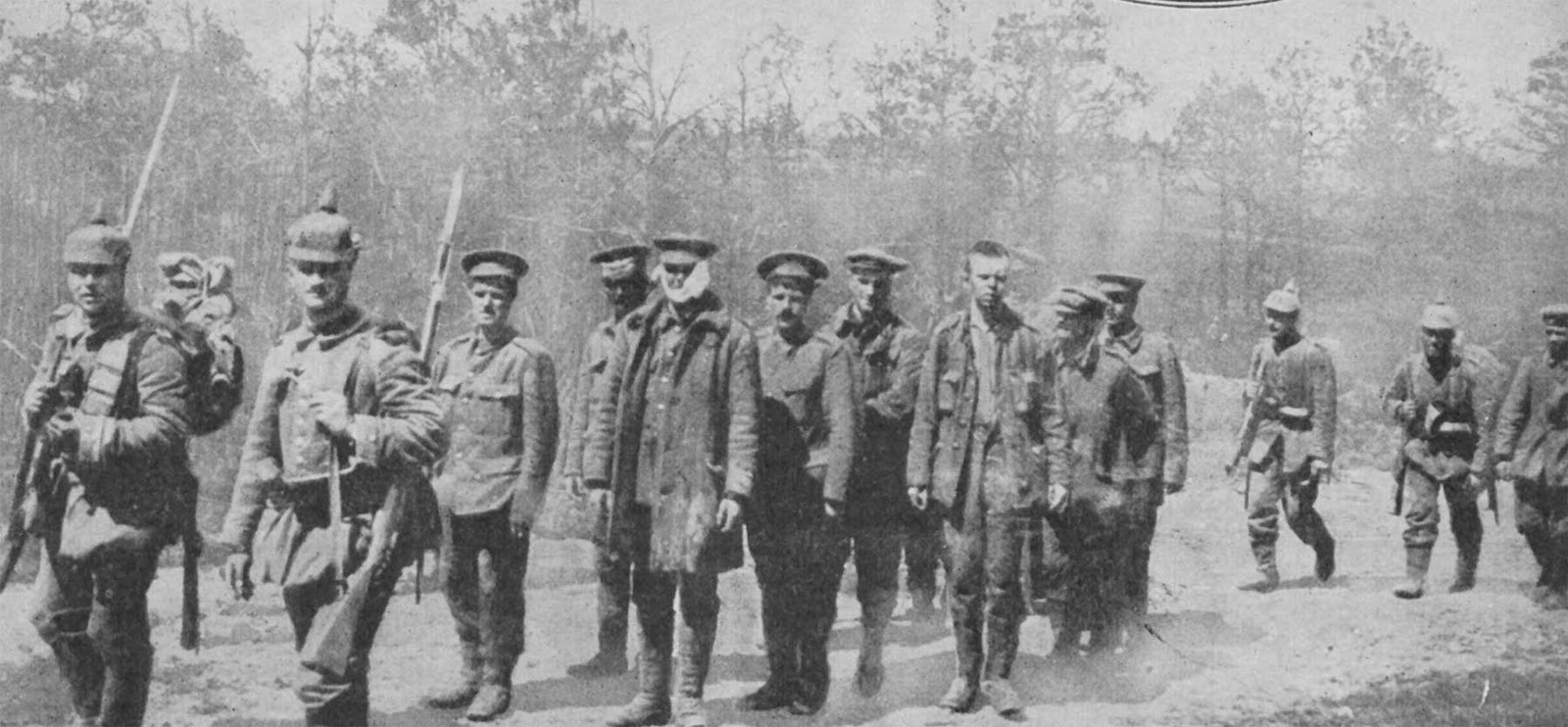
British soldiers being marched into captivity (1915)

His relatives didn’t receive news of his capture until November, such was the time it took for the information to filter through the channels of the Red Cross. In captivity his health deteriorated to the extent where, in February, 1916, he was repatriated under a prisoner exchange scheme. On arrival back in the U.K. he was interviewed about his experiences as a prisoner of war, the information gleaned being used by the authorities to assess how well the men in captivity were being treated.


Reptriated British prisoners of war (1916).

A transcript of his interview has survived in the National Archives (Catalogue File WO/161/98 pp 325-327). It makes for fascinating reading.


Interview No. 326.


Home Address: 29, Settle Street, Millom, Cumberland.

Name, Rank and Regiment: Hall, Stanley, Lance Corporal, No. 10983, K.O.R.L.

Place and Date of Capture: Cambrai, 27 Aug. 1914.

Nature of wound, if any: Nil.


Journey. Aug. 27-28. 1914.

Witness was captured at Cambrai in the course of street fighting when two companies of his regiment were out-numbered in the dusk. His overcoat and money were taken from him on capture and were not restored.

He was taken in a motor-wagon to Halle, and then by train to Germany. The journey lasted 37 hours. Bread was issued, but it was difficult to get water. Prisoners travelled in carriages. The guards on the journey behaved well, but the civil population spat on prisoners when the train stopped.

Sennelager I. Aug. 28, 1914 – Aug. 27, 1915.

Accommodation.

Witness was housed in a stable which contained two stoves, but was cold since little fuel was supplied. A palliasse and two blankets were provided. Washing accommodation was poor, six bowls for 120 men. There were in addition horse troughs and two taps. Soap could be bought after the first few weeks. There was a bath-house where a bath could be obtained once in six weeks or two months. Sanitary arrangements were very defective, open trench latrines near the building.

Two huts were set apart as a hospital for the sick, in which there were a few bedsteads, but not enough to accommodate all the patients. If a man could walk at all it was difficult to obtain admission to the hospital, and little treatment was given when there. The doctor had been a prisoner in France and took no trouble. Witness was sent to this hospital for a fortnight since he was losing flesh and was given extra food to put on weight. The extra food consisted of about 1 ounce of white bread a day. Witness appeared to be in an advanced stage of phthisis.

Food.

The food is described as “terrible,” insufficient and bad, sometimes unfit to eat. Coffee only was issued in the early morning before the men went to work. Dinner consisted of a bowl of soup of some description, very watery at first, but somewhat thicker after. Bread was issued in the evening, with a piece of sausage or pickled fish. For some months past the bread ration has been about one slice per man, 10 to a loaf. There was a canteen where soap and margarine could be bought at fair prices. Food was received from England, sometimes in bad condition in consequence of having been packed in tins. Witness started that wooden boxes are preferable to tins.

Clothing.

Witness kept his own clothing and only received two shirts and a pair of drawers from the Germans. He did not ask for more as he had some sent from home.

Exercise.

There were at first no facilities for exercise in the camp, but the men walked 6 miles each way through swamps to work at agricultural labour. No payment was made. Witness heard of attempts to make prisoners work on munitions. Prisoners invariably refused, and were said to have been punished for their refusal by imprisonment and deprivation of food. The first commandant, from August 1914 to June 1915, was a martinet, who hated the English and treated them worse than other nationalities. He was succeeded by an under-officer who accorded better treatment and allowed boxing, concerts &c., which the former would not permit. Smoking was allowed outside the bungalows. Indoor games were permitted if the prisoners had them.

Religious services were held for R.C.s every day, but not for other denominations until the under-officer, who was appointed as commandant in June permitted an English corporal, who was a divinity student, to hold services. This corporal was also allowed to continue his studies for ordination.

Discipline.

Nothing special to report under this head. Notices in English were posted on doors prohibiting smoking in huts and setting out regulations for keeping hours. Breaches of the rules were punished by making a man stand in the sun or tying him to a tree for two or three hours. No complaint of cruelty.

English were harassed more than the French. If an offence were committed and the perpetrator could not be discovered, all the prisoners were paraded, the French were allowed to fall out in a few minutes, but the English were kept standing for some hours.

Illnesses.

There were no epidemics.

Postal Arrangements.

Letters and parcels came regularly and were opened in the presence of the prisoners. Newspapers and matches were not allowed. Prisoners were permitted to send four postcards and two letters a month. Postcards were received quicker than letters.

American Ambassador came to the camp but did not visit witness’s bungalow. Everything was tidied up under orders before his arrival, but no improvement followed.

General Conditions.

The food was bad till May, but got a little better after that time. On returning from work, men often had to wait three or four hours in rain to draw rations.

Irish prisoners were not allowed to mix with the English. Witness knew nothing of Sir Roger Casement.

In September 1915, witness saw a doctor at a factory where he was engaged in unloading wagons and was ordered to hospital.

This man’s most serious complaint related to the food on which men were expected to work. A long working party worked from 6 a.m. top about 3 p.m. A short working party worked from 6 a.m. to 11 a.m. Coffee was issued at 5.30 a.m., but no solid food was provided with it, and unless a man had kept a portion of bread from the previous day’s rations, he had absolutely nothing to eat until he returned from work. To this the witness attributes the illness from which he is now suffering.

Dortmund. Sept. 1915.

In September 1915, while at Sennelager, this man got attached to a working party at Dortmund, in the hope of getting better food. He was there employed in unloading wagons. He was seen by the doctor at the factory who ordered him to hospital. He was sent to Rennbahn No. 2 Camp for four days, and there examined by a Russian doctor, who prescribed “No work.” He was, however, made to work the day before he left. Next morning he was ordered by a German doctor to the Münster Lazaret. The journey took two hours by train and was accompanied by no particular incident. He was in the charge of a nice sentry.

Münster Lazaret. Treatment in Hospital. Sept. 1915 – Feb. 1916.

In October the witness had pleurisy and was in bed for 10 days, and in November he grew weaker and his chest became bad. He was then ordered to bed, where he remained until exchanged. He had little medicine and no nursing. The food was similar to that supplied in Sennelager Camp i.e., insufficient in quantity and inferior in quality. The sanitary conditions are described as “not too bad.” The Russians were treated worse than other nationalities.

Clothing.

Hospital clothing was supplied. From September to February he had one hospital suit and two changes of underclothing. The sheets were changed once.

Postal arrangements described as “all right.” He returned to England in his own clothing.

Opinion of Examiner as to intelligence and reliability of informant.

The witness is intelligent and, in my opinion, reliable.

Digby L. F. Koe
10th February 1916.

A month later, on March 23rd, 1916, Stan Hall died.